| Home | Galleries | Articles | Reviews | Best Gear | New | About | Contact | Gallery Index | Previous |
Next |
| Home | Galleries | Articles | Reviews | Best Gear | New | About | Contact | Gallery Index | Previous |
Next |
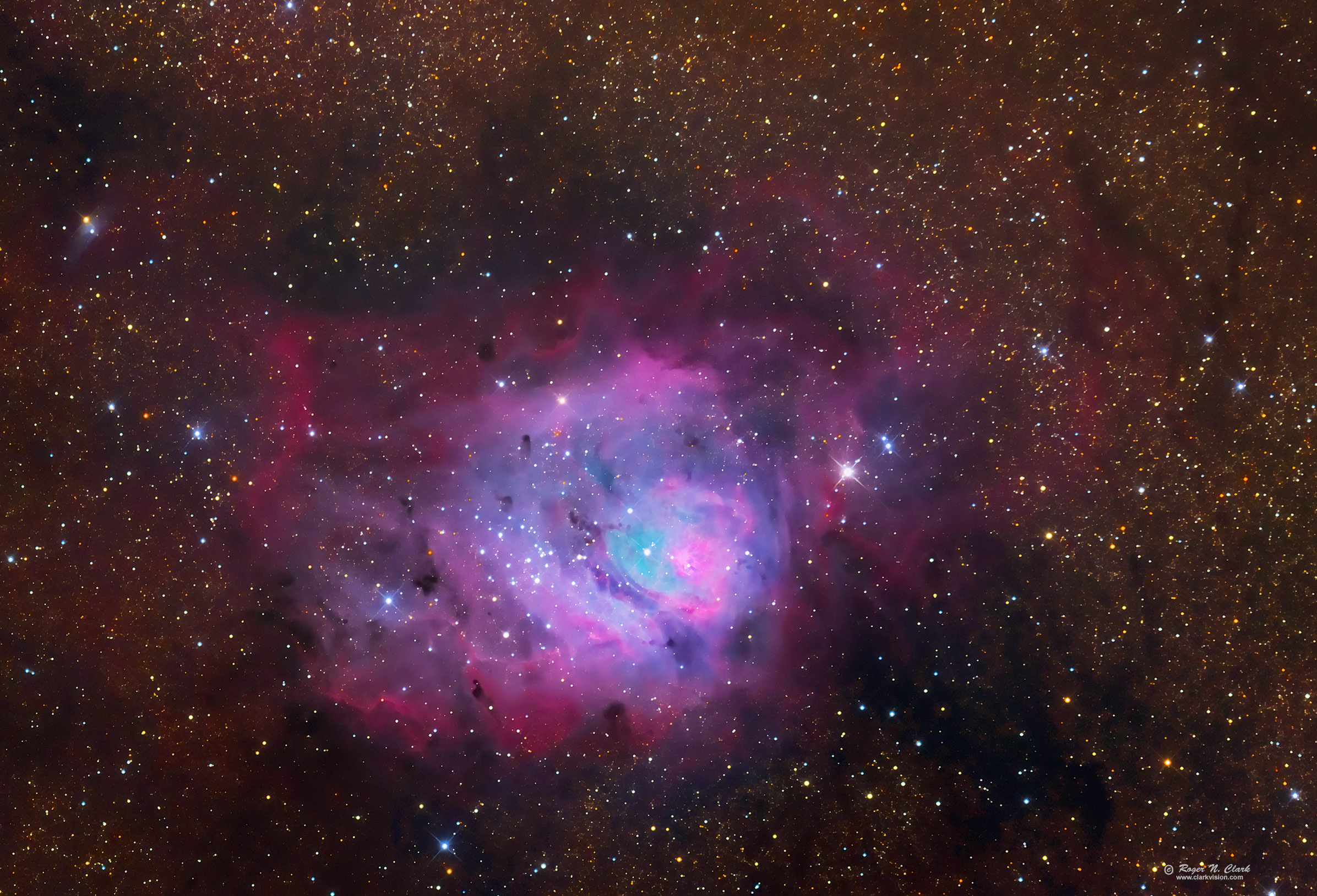
M8, the Lagoon Nebula in Sagittarius rises high in the summer for northern hemisphere observers. The nebula is called an HII region, an area where new stars are being formed. The nebula is surrounded by reddish-brown interstellar dust near the core of the Milky Way galaxy. The bluish-green (teal) in the center is due to oxygen emission. The pink/magenta is from hydrogen emission due to emission from red H-alpha, plus blue H-beta + H-gamma + H-delta. Between the pink hydrogen emission and teal oxygen emission are blue tones. This is a mixture of oxygen and hydrogen emission. You can see this mixing line in Figure 9 in my Color of Nebulae and Interstellar Dust article. The pink turns redder in the outer fringes of the nebula, because interstellar dust is absorbing some of the blue hydrogen emission light. These colors can be seen in large amateur telescopes from very dark sites when the object is high in the sky. I have seen these colors in 10 to 12-inch aperture and larger telescopes, though more pastel in color because M8 was viewed from mid-northern latitudes so not very high in the sky. Stars in the image also have wonderful colors, ranging from blue to yellow, orange and red. The color indicates the star's spectral type and its temperature. In the very outermost parts of the nebula is faint blue nebula. That is light scattered from dust near the nebula and illuminated by the many blue stars in the nebula. It is amazing how much astrophysics that a stock digital camera shows with a simple natural color image.
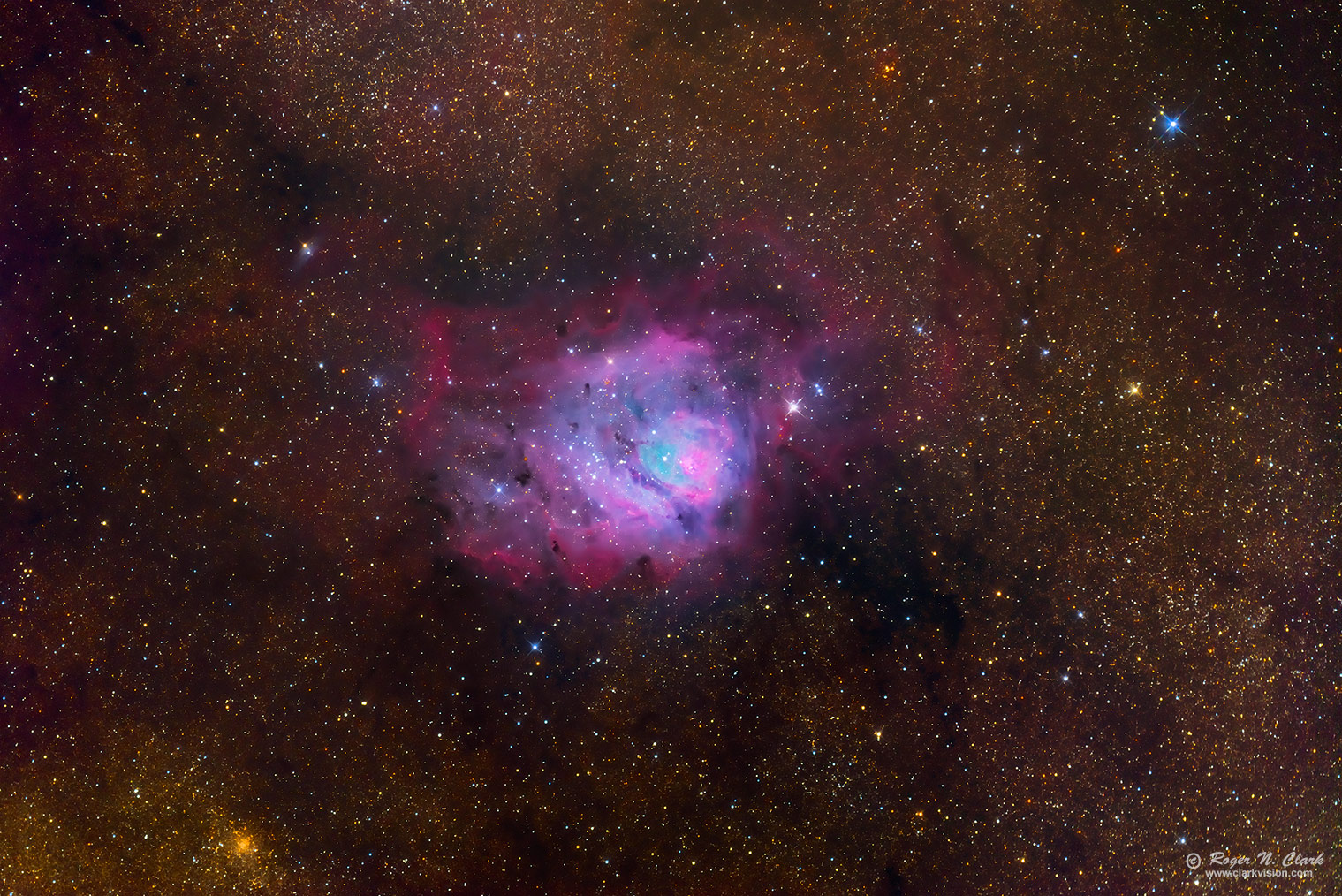
Technical. This image was obtained with a stock Canon EOS R5 Mirrorless 45-megapixel digital camera and a homemade 8-inch aperture (200 mm) f/4 astrograph. Focal length = 803 mm. Raw conversion with rawtherapee. Rawtherapee used the bias in the image files exif data and is a single value for all pixels. The camera suppresses dark current, so no dark frames were used. A single flat field was used in rawtherapee, with smoothing (equivalent to over 3200 flatfields). Exposure was 105 frames at 20 seconds each (35 minutes total exposure time) at f/4, ISO 3200. The exposures were tracked on an iOptron HAE29EC strain wave mount with no guiding (the mount has Real Time Periodic Error Correction, RPEC, without autoguiding). Seeing was very poor, about 5 arc-seconds full width at half maximum, and haze from smoke colored and dimmed the nebula and stars and turned them yellower. White balance compensated for the smoke. The sky was borderline between Bortle 3 and 4. Full resolution image is 1.127 arc-seconds/pixel. This image is at 1/2 that resolution (2.25 arc-seconds/pixel). The image below shows the full field after stacking.
Post processing. Raw conversion in rawtherapee to Rec2020 color space. The astrograph with coma corrector produced good geometry over the central 80% of the full frame field of view, but geometric distortion was larger beyond that so that Deep Sky Stacker failed to register the outer 20% of the image. Siril was use to plate solve and derived the distortion, and Siril was used to stack. Stretched with rnc-color-stretch then star reduction applied. Also see Astrophotography Image Processing Basic Work Flow. The stretch settings followed this article: Black Point Selection in Astrophotos and used a darker area in the stacked image.
This is a natural color image. The raw data were converted with rawtherapee with full calibration that included the color correction matrix and hue corrections usually skipped in the traditional astro workflows. Color managed workflow in Rec2020 color space. Stretched with rnc-color-stretch, and final adjustments in photoshop. This is a highly calibrated image, presented in sRGB color space.
The Exposure Factors, CEF, CEFA are measures of the relative amounts of light received from a subject. It can be used to fairly compare wildly different lens/telescope apertures and exposure times. For this image:
The image below shows the full frame after stacking and trimming edges from dithering. The Canon R5, a 45 megapixel camera, produces a 2.56 x 1.71 degree field of view with 1.127 arc-seconds per pixel.
Modern digital cameras like the R5 include on sensor dark current suppression and low fixed pattern noise at ISOs around 1600 and higher, making no need for dark frame subtraction.
To learn how to obtain stunning images like this, please visit my Extensive Articles on Photography .
Keywords to this image = astrophoto-1 nebula Messier low-light digital_astro canon_r5 rnc-color-stretch NEW
Image ID: m8-8inch-f4-rnclark-2026-06-17-4C3A1822-1959-av105-g-c1-0.5xs.jpg
| Home | Galleries | Articles | Reviews | Best Gear | Science | New | About | Contact |
Last updated June 23, 2026