| Home | Galleries | Articles | Reviews | Best Gear | New | About | Contact | Gallery Index | Previous |
Next |
| Home | Galleries | Articles | Reviews | Best Gear | New | About | Contact | Gallery Index | Previous |
Next |
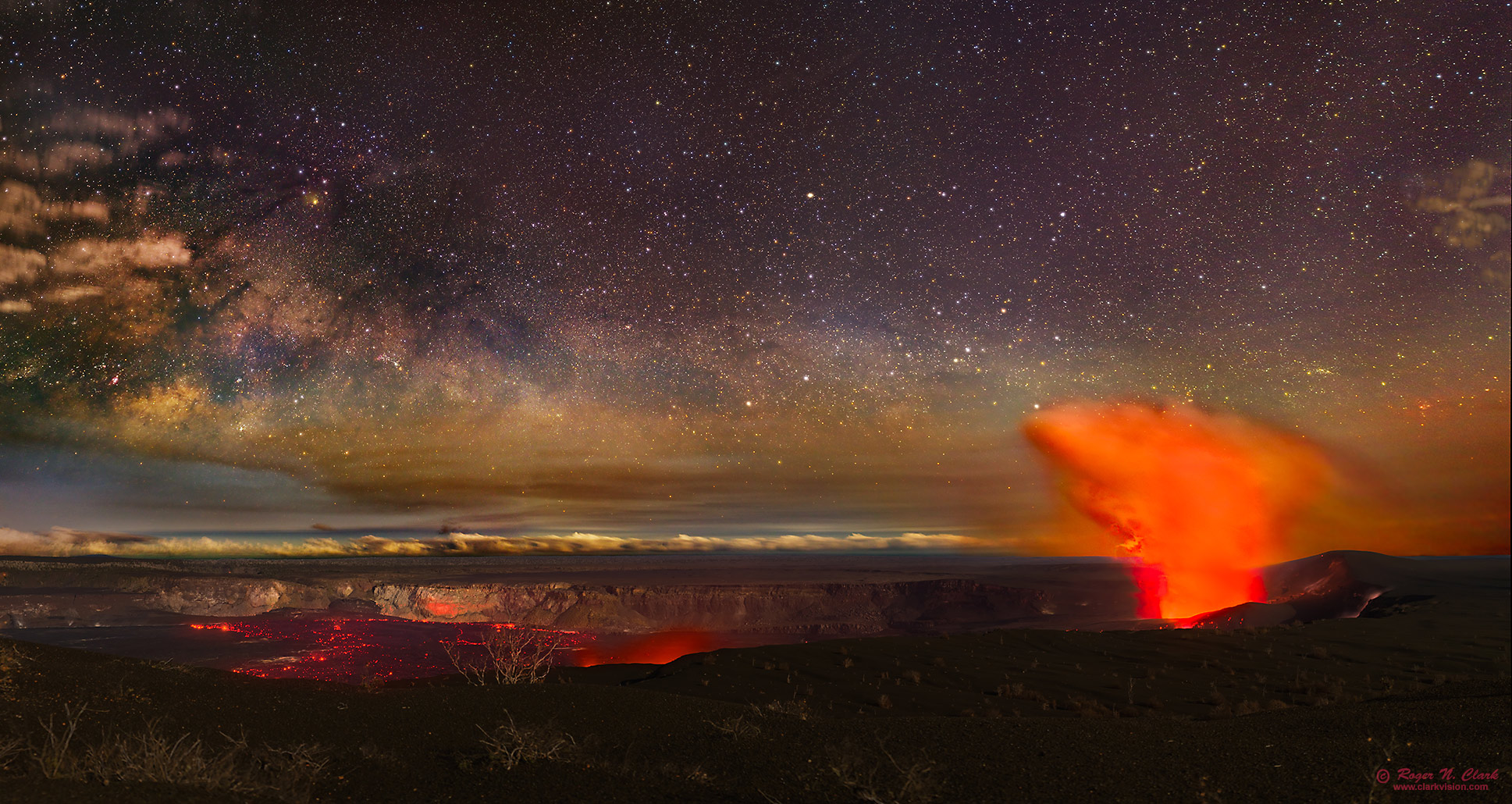
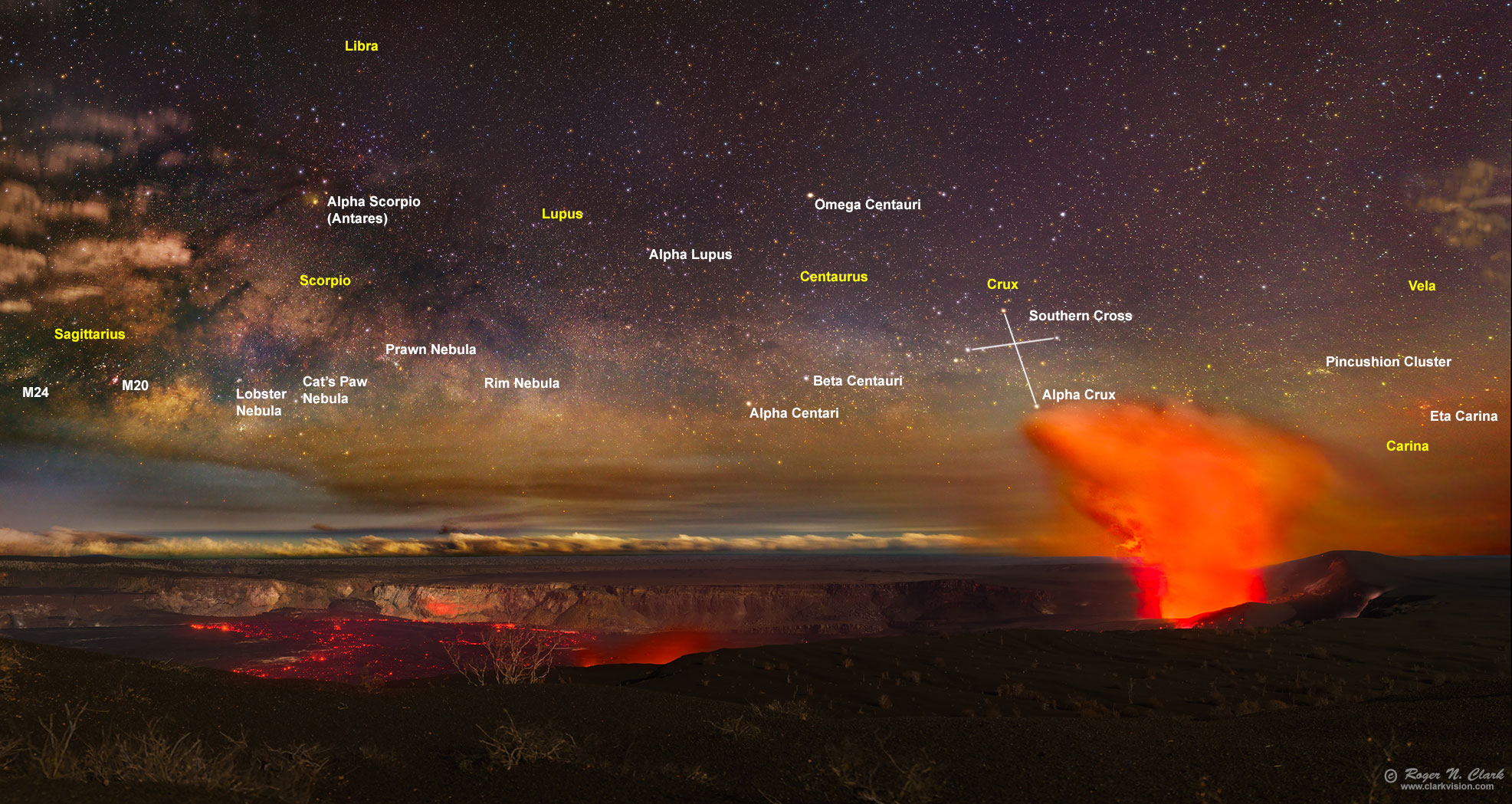
This view is a nightscape of Kilauea volcano eruption with the Milky Way from Carina to Sagittarius. Halema'uma'u eruption fountaining episode 45 just completed, covering much of the Kilauea caldera with lava. It was one of the most awesome sights of nature that I witnessed with fountain heights over 1000 feet high. On the right, smoke plume post fountaining, and the low lying clouds throughout the image are lit by red glowing lava. Stars, deep sky objects, and constellations are labeled in an image below.
All lava is red or red-orange. Yellow and white lava are due to camera saturation of the red channel with the green channel near saturation, or white due to both red and green saturated and the blue channel near saturation. Lava temperatures run from around 600 to 1200 degrees Centigrade, and the dynamic range in the visible over these temperatures is over 20 stops (1:1,000,000), which no camera can cover. Therefore to show cooler and fainter lava, the higher temperature lava will be saturated in the camera images. For more info, see Volcanoes and the Color of Lava.
See my youtube video of the fountaining eruption: Kilauea Volcano Night Eruption, Halema'uma'u Episode 45, April 22-23, 2026.
Technical. The image is a 4 wide by 3 row high mosaic with a Canon EOS R5 45 megapixel Mirrorless Digital Camera, Sigma Art 40mm f/1.4 DG HSM lens, at f/1.4, and ISO 1600. Made with a static tripod, ISO 1600, f/1.4, and 6-second exposures on the sky, 10 seconds on the land (112 exposures total). The sky was made up of 10 or 11 exposures at each mosaic position, and the land was made up of 3 to 5 ten second exposures at each mosaic position.
The final full resolution mosaic is 15496 x 8329 pixels.
The Moon, just past 1st quarter was low in the western sky.
Exposures:

Land east to west:
Land 1: 5 (50 seconds total)
Land 2: 3 (30 seconds total)
Land 3: 4 (40 seconds total)
Land 4: 4 (40 seconds total)

Sky at and just above the horizon, west to east:
Sky 1: 11 (66 seconds total)
Sky 2: 10 (60 seconds total)
Sky 3: 10 (60 seconds total)
Sky 4: 11 (66 seconds total)

Sky, top row, east to west:
Sky 1: 10 (60 seconds total)
Sky 2: 10 (60 seconds total)
Sky 3: 18 (108 seconds total)
Sky 4: 10 (60 seconds total)

Total exposure times:  Land = 160 seconds (2.67 minutes),
                        Sky = 540 seconds (9 minutes)
This is a natural color image. How do we know the colors are reasonable? The star colors can be checked against stellar photometry. Red stars have B-V > 2, orange stars have B-V of 1 to about 2. The blue-white stars have B-V in the range of 0 to -0.5. The colors closely follow the color sequence in Table 1 at Color of Stars. Solar-type stars have a B-V of 0.63 and appear close to white (daylight white balance). Less than 1% of stars in the Milky Way are blue. Interstellar dust is brownish in color, not the typical fake blue we see in many Milky Way photos we see these days on the internet. For more on natural color in the night sky see Parts 2a, 2b, 2c and 2d on Color of the Night Sky and proper post processing to show those colors.
To learn how to obtain stunning images like this, please visit my Extensive Articles on Photography .
Keywords to this image = astrophoto-1 nightscapes night low-light digital_astro hawaii volcano large_format canon_r5 mosaic NEW
Image ID: kilauea-nightscape-rnclark-2026-04-23-r5-40mm-4C3A0431-562-f-1937s.jpg
| Home | Galleries | Articles | Reviews | Best Gear | Science | New | About | Contact |
Last updated June 07, 2026